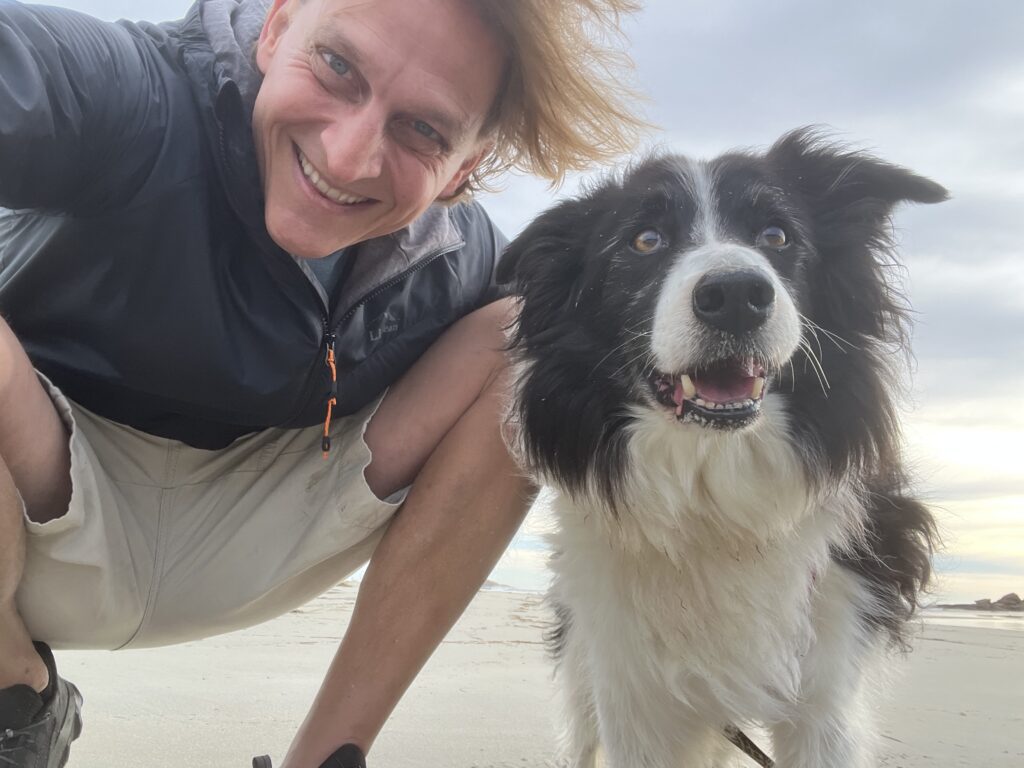
The Long, Strange Trip to GT Smiles
In retrospect, GT Smiles is the natural convergence of the many paths I’ve walked in my career, but it wasn’t always clear I was headed anywhere in particular.
A Brief Background
At Dartmouth College (go big green!) I studied tropical ecology, marine ecology, and developmental genetics. It was several decades ago – concerns about plastics weren’t as widespread, but they already existed in these fields. And the concerns stayed with me.
I spent a few years after graduation at Health Advances, a strategic consulting firm for medical device and biotech companies, where I had the coolest job, figuring out how to translate complex medical science into accessible language for the business teams. In the process, I acquired what felt like multiple PhDs worth of science knowledge along with a solid introduction to the business side of medical devices.
Then I took a huge detour into internet technology and spent a decade accidentally helping create social media:

The term didn’t even exist at the time, but that’s where I learned to develop “cloud-based web applications”. Millions of vocal users helped us figure out how to design for ease-of-use and scale.
As social media evolved away from its fun and friendly roots toward… well, something else, the call back to medical science grew stronger, and I co-founded Good Fit Technologies.

Good Fit’s initial focus was the development of denture-related technology that my father had been exploring during his career as a prosthodontist. (I’m the son and grandson of dentists, which helps explain an otherwise unreasonable drive to please folks in this field.)
Dentures are made of acrylic, a type of plastic, so the work at Good Fit took me on a deep dive into polymer chemistry.
An Opportunity to Help Millions of Patients
Polymer science, it turns out, is fascinating. The simple joy of exploration drove me into years of research that culminated in multiple patents worldwide – all related to polymer science for dentistry.
But the bigger draw in all of this research was that the target products we had in mind were ones that could help millions of patients worldwide. They were a new family of devices that could help make dentures quickly and affordably, without sacrificing quality.
And they were products that simply didn’t bring to mind concerns about plastic waste. Yes, dentures are made of plastic, but:
- There’s very little wasted material when making a denture and
- Each denture is then used for years, sometimes decades, before needing replacement.
I’d personally been wary of plastic waste since college, and yet (fair or otherwise) acrylic dentures triggered no immediate alarm bells for me.
Then we got into aligners…
“I’ve got a bad feeling about this”
By the late-2010s, orthodontic aligners and retainers had become one of the fastest-growing segments in dentistry.
Good Fit was already known for its focus on specialty polymers for dentistry, and the aligner industry depended on polymers. So around 2020, when I called my friends in the industry to let them know we had a new polymer (plastic) designed specifically for aligners and retainers, things got busy – and concerning – quickly.

Here I’ll take a moment to admit I should’ve easily seen the problem coming. The amount of plastic waste in the aligner and retainer industry is obvious and staggering – if you look. But we dove into it relatively blindly, focusing so closely on the science that we missed the looming problem of waste… until we were part of it.
The plastics that have become popular for making aligners and retainers are essentially not recyclable.
To be fair to any companies claiming recycling programs, I’ll say that the materials are so impractical to recycle that any such programs are unlikely to scale enough to have a meaningful impact.
And 100% of the plastic used to make aligners is single-use plastic waste.
It’s somehow even worse than it first sounds. 90% of that waste occurs in the process of making each aligner. The finished aligner is only about 10% of the starting material. (It’s even worse than that if you take into account the waste at the factory making the plastic itself.)
Then that last bit – the aligner itself – is used for about two weeks and discarded, into a sea turtle.
These concerns hit us almost the moment we started selling our aligner material. But when we finally attracted one of the big aligner companies and got an initial order for 20 kilometers worth of material in roll form, we knew we had to do something about it.
I remember the moment well, like you remember a trauma. I grew up in the Boston area and couldn’t help picturing our roll of plastic material lining the entire length of the Boston marathon. It was nauseating, but motivating.
And it led to GT FLEX ® GREEN… and GT SMILES.
I’ll ask that you check out the “about us” page for the details, but it’s been quite the journey transitioning from “plastics expert” to “plastics expert trying to get rid of plastics“.
And though this post is supposed to be about me, it goes without saying that none of this could have come to pass without an amazing team of colleagues – each of whose livelihood depended on plastic, but none of whom hesitated for a second to try to help move the world beyond traditional plastics.
Two Roads Converged…
(With a nod to Mr. Frost) I have trouble choosing roads, so I explored many, none well traveled, and somehow all meeting here at a new one called GT Smiles.
Hope to see you on the road.
– Marc
If you haven’t read it already, the story continues on our “about us” page…